
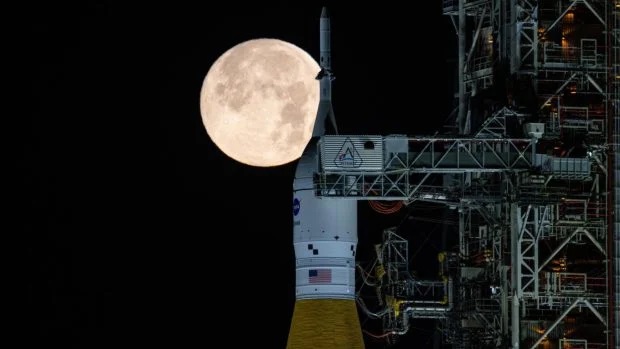
Artemis II and Environmental Pollution
The Artemis II mission orbited the Moon half a century after the last human footprint on its surface. How much does this achievement cost the planet, and what are its benefits? Are the priorities of the Artemis program aligned with the real needs of planet Earth?
NASA’s efforts to reduce the environmental footprint of this mission are present, especially using liquid hydrogen as the main fuel. This type of fuel, when reacting with liquid oxygen, primarily produces water vapor.
However, this statement requires context. Water vapor released at high altitude—especially in the stratosphere—also acts as a greenhouse gas, contributing to warming in sensitive atmospheric layers.
Nevertheless, this approach represents an important difference compared to kerosene-based rockets from SpaceX or the old Soviet Soyuz rockets, whose combustion releases black soot (black carbon) directly into the atmosphere. This pollutant can remain in the upper atmosphere for 3 to 5 years, contributing to global warming.
Space launches to the Moon impact the environment mainly through:
- Emission of greenhouse gases
- Release of black carbon into the stratosphere
- Generation of space debris in Earth orbit
- Accumulation of waste on the lunar surface (equipment and materials from past missions)
Although the number of launches is still low compared to other industries, the rapid growth of the space sector—driven by public and private actors—raises increasing concern within the scientific community.
The critical point is not to stop exploration, but to understand it fully:
every technological advance has an environmental cost that must be measured, communicated, and transparently managed.
Source: BBC London, NASA